
Table of Contents
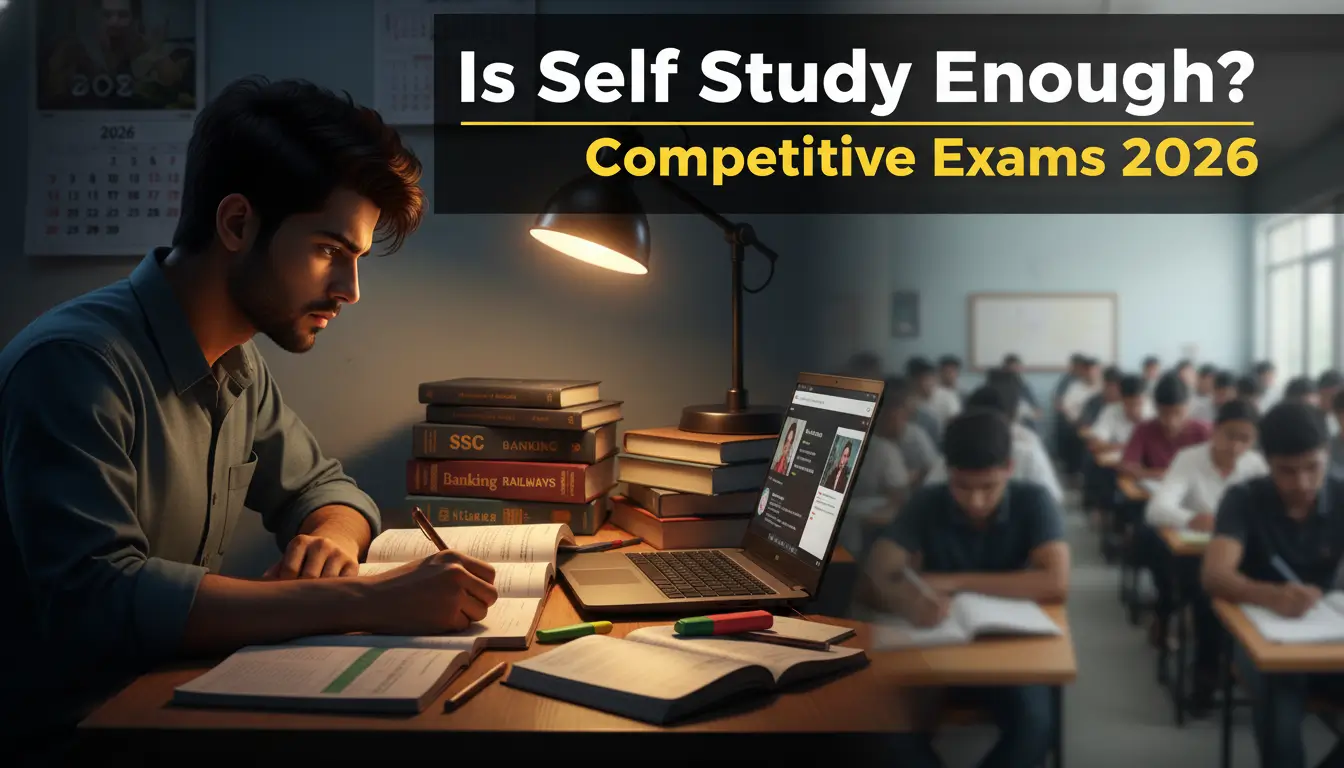
Is self study enough for competitive exams in 2026? This question is on the mind of every student who prepares for competitive exams like SSC, UPSC, Banking, Railways, Defence and State PSC. Today, there are so many online courses, coaching centers, YouTube channels and paid mentorship programs available that it is perfectly normal to feel confused. Some people argue that coaching is necessary to keep oneself motivated and engaged. Others say that if preparation is done smartly, then self-study is the best.
I have experienced both sides very closely. I have followed coaching materials along with self-study. Based on my own real experiences and current exam trends, let’s consider whether self-study alone is indeed sufficient to crack competitive exams.

What is the real meaning of self-study?
Many people think “self-study” means merely sitting at home studying alone at home without any external assistance. But it really means taking complete responsibility for your preparation. You choose your own books. You plan your own schedule. You identify your own mistakes. You track your progress. And you resolve your doubts with the help of books, videos, or online resources. All of this sounds easy to do, but in reality, it requires a lot of discipline. It’s important to understand that self-study is a mindset, not just a method.
That’s why self-study isn’t limited these days. Information is readily available.
📌 If you are a beginner and preparing for competitive exam, don’t make these 10 common mistakes. Read Here
Why Self-Study Is More Possible in 2026?
10-15 years ago, coaching was considered almost essential to crack competitive exams. But things have changed today.High-quality study material is now easily available online. Top educators upload free content to YouTube, and daily current affairs are available on Telegram channels. Previous years’ question papers are easy to find, and mock tests can be taken from home. There is no longer any shortage of resources. In essence, an entire digital library is available on your smartphone. The study materials that were once accessible only within coaching institutes are now right at your fingertips. Now, even a student living in a village can access and study the exact same content as a student living in Delhi.
That is why self study is a much better option in today’s time.
The Major Benefits of Self-Study
The biggest advantage of self-study is that you can study at your own pace. Self-study gives you the opportunity to devote extra time to those specific topics in which you feel weak. In a coaching institute, you have to keep up with the teacher’s pace. However, with self-study, you have complete control over your learning speed. This flexibility is very helpful in long-term exam preparation.
Another advantage of self-study is that it saves both your time and energy. For instance, if it takes three days to cover a particular topic in a coaching class, you can complete that very same topic in just two days at home by utilizing digital resources. Coaching institutes operate on fixed schedules; you have to attend classes every day. You have to travel daily. This wastes a lot of your time and energy. Self-study saves all this time. You can use that time for revision and practice.
Self-study makes you responsible. It instills discipline in you. Being able to teach yourself when no one is around is a big victory. Competitive exams don’t just test knowledge; they also test patience and consistency. Self-study provides the necessary training for both of these qualities. You make your own notes and have to search for answers to questions yourself. This deepens your knowledge and makes it easier to remember.
📌 Also Read: How to stay consistent during exam preparation? Here’s the Solutions
Challenges Faced in Self-Study
a) Distraction from Study
To be honest, while the path of self-study appears powerful, it is not exactly. You have to face some challenges. The biggest challenge is distraction. When you study alone, addictions to social media and your phone can act as significant roadblocks. In a coaching institute, you find a specific environment where seeing others study inspires you to do the same; at home, however, you have to create that environment for yourself.
b) Lack of Direction at the Start
The second problem is deciding “what to study and what to skip.” There is such an overwhelming amount of content available on the internet that students often get confused. Which book should I follow? Which topic should I read first? How much should I study each day? Without proper guidance, students often waste a lot of time. I faced this problem too. In the beginning, I collected too many books, which only increased my confusion.
c) No Immediate Doubt Resolution Support
When you study alone, your doubts often remain unresolved for extended periods. Not every doubt can be easily resolved through Google searches or online videos. Sometimes, personal explanations are needed. This lack of immediate support can slow down the learning process.
d) The Risk of Inconsistency
Self-study requires strong self-control. When studying without external guidance, motivation can begin to wane within just a few days. It is for this very reason that many students eventually give up on their studies altogether. Following a proper routine in self-study is crucial for consistency.
e) Absence of a Feedback System
In a coaching institute, teachers correct your mistakes and provide feedback. In self-study, however, you must identify your mistakes yourself and take the necessary steps to improve. Therefore, proper analysis of mock tests becomes crucial.

When Does Self-Study Work?
a) NCERT and the Basics
To achieve success through self-study, you must strengthen the basics of every subject. NCERT textbooks for classes 6 to 12 are your best weapon for this. These books are written in very simple language. Make notes from these books and study them diligently.
And if your basics are already clear, self-study may be sufficient. Self-study proves particularly beneficial for repeat aspirants, as they are already familiar with the syllabus. They just need practice and revision.
b) Right Use of Digital Tools and AI
Today is the era of AI. AI tools like chatbots can be a great help in your studies. If you don’t understand the meaning of a paragraph, you can ask the AI to explain it in simple language. But remember, AI is a tool, not your teacher. Use it only to clear doubts. Spending all day in front of a screen can reduce your concentration.
c) Mock Tests and Previous Year Questions (PYQs)
When studying without formal coaching, how do you know whether you’re moving in the right direction? The answer lies in mock tests. Many students wait until they’ve completed the entire syllabus before taking any mock tests, which is a big mistake.
It’s important to review previous year question papers right from the very first day of your preparation. This practice helps you understand current exam trends. By analyzing these papers, you can identify which subjects require more intensive study and which subjects typically carry less marks.
Along with studying, it’s also important to take mock tests. This helps gauge your preparation, correct mistakes, and increases your speed, which helps you during exams. I have always recommended that you attempt at least 50 to 100 mock tests.
d) Discipline and the ‘No Zero Day’ Rule
The most difficult thing about self-study is maintaining consistency. To achieve this you can use the ‘No Zero Day Rule,’ which I also adopted. This rule means that there shouldn’t be a single day when you study zero.
Even if you’re sick or there’s a function at home, make sure to study for at least 15-20 minutes. This keeps your study consistency intact. If you skip studies even for a day, it can take several days to regain focus.
If you can study with this kind of self-discipline, you don’t need full-time coaching. Many students achieve success by studying on their own with limited external support.
e) Health and Mental Peace
Often, students neglect their sleep and physical health in the pursuit of studies. This is a big mistake. If your body and mind are not healthy, you will not be able to remember what you study. That is why this should not be ignored at all.
Make sure to get at least 7-8 hours of sleep a day. Take some time out for yoga or a walk. I have personally experienced that 4 hours of studying with a calm mind is better than 10-12 hours of studying with a stressed mind. Stay connected with your family and friends. Do not let your exam preparation consume your entire life; it is just a part of life.
📌 Also Read: Lucent Vs Arihant? Which GK book is best for competitive exams? Here’s the Full Comparison
When to Add Coaching or Mentorship
Self-study doesn’t mean you should completely isolate yourself from any help. A beginner often needs direction. In such situations, a mentor can clear up all your doubt and confusion. If your basics are weak, or you’re confused about what to study or which books to follow, guidance is helpful.
For this, you can take paid short-term courses, doubt-clearing sessions, or mentorship programs that support your self-study efforts.
👉Want more clarity on self study vs coaching? This video explains it in a simple way. Watch Here
Conclusion: Is it enough?
In conclusion, I would say that in the year 2026, self-study is not only sufficient, but also the most effective method. But it must be done correctly. Coaching can only show you the path; you have to walk it yourself.
If you have the right plan, discipline, and patience, if you focus on NCERT, and take mock tests every week, no one can stop you. It may not be easy, but it’s very powerful. Selection isn’t achieved by spending lakhs of rupees, but by hard work in the right direction.
Don’t blindly follow others. Believe in yourself. Choose the method that works for you. Remember, no teacher can study on behalf of you. And no coaching can replace your hard work.
Ultimately, success in competitive exams depends on how sincerely you study, not where you study. Give your preparation a new direction starting today. You’re not alone; you have the best resources in the world and your own hard work.
If you’re consistent, self-study can take you a long way.

Hi, I’m an exam aspirant who has successfully cleared SSC and other government exams, and I’m currently preparing for the UPSC.
I love writing and creating content for fellow aspirants. Through StudyBlink, I share study hacks, book reviews, and exam strategies to help you stay motivated and succeed in your journey.