

If you ask any aspirant, “What is the biggest headache when preparing for competitive exams?”, 90% of the students will answer GK/GS i.e. General Knowledge and General Studies. This is because its syllabus is so vast, as if the entire universe is included in it. History dates, Geography maps, Politics articles and Science facts. Remembering…
Table of Contents
If you ask any aspirant, “What is the biggest headache when preparing for competitive exams?”, 90% of the students will answer GK/GS i.e. General Knowledge and General Studies. This is because its syllabus is so vast, as if the entire universe is included in it. History dates, Geography maps, Politics articles and Science facts. Remembering all this is really very difficult.
If you are also struggling with the same issue, then you are not alone. I myself had to struggle a lot in remembering GK during exam preparation. I’ve learned one thing in my journey: you cannot master GK/GS simply by rote learning. Over time, I have developed some practical methods that really work.
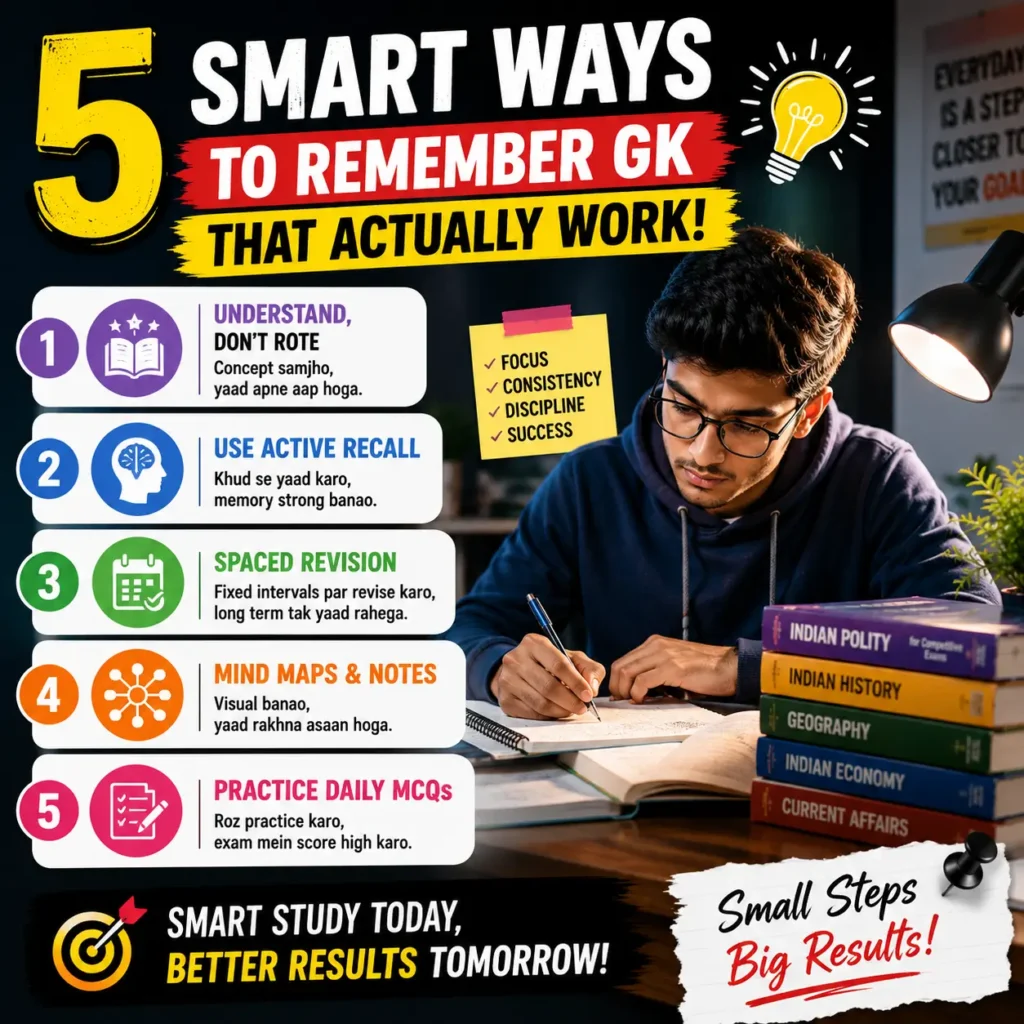
You just need to change your approach, not the amount of hard work you put in it. Today, I will share 5 smart ways to memorize GK/GS that aren’t just theory. These are real methods I’ve used myself and have proven to be very beneficial. If you are targeting the 2026-27 exams, this post will be a game-changer for you.
Why is it difficult to remember GK?
Before we exploring the smart ways, it’s important to know that most students study GK the wrong way. You do not forget GK because your memory is weak. You forget because you absorb information passively. Meaning, our brains forget things quickly when they are memorized without any connection, image, or emotion. They only remember things that seem interesting, that connect, and that we use again.
Research shows that if information isn’t revised or recalled, we forget a large portion of it within a few days. Therefore, the solution isn’t simply to read more. The solution is to study smarter.
Now let’s look at five smart methods that help us remember GK for the long term.
📌 Also Read:- Is self-study enough for competitive exams ? Know the truth.
1. Make Connections Between Stories and Logic
This is my favorite technique. Our brains forget facts quickly, but they always remember stories. If I ask you about a movie you saw three years ago, you’ll remember the entire story. Why is this? Because it had a narrative flow, a connection. You need to do the same when studying GK.
History is a great example of this. Instead of memorizing dates individually, try to understand the story behind them. For instance, if you are studying the Battle of Plassey, don’t just remember the year 1757. Understand what the dispute was between Siraj-ud-Daulah and the British. How Mir Jafar betrayed them. When you visualize the entire sequence of events in your mind like a movie, the dates will stick in your memory naturally.
When I started studying history as stories, my retention improved significantly. Even today, I remember many historical events simply because I understood them as stories instead of facts.
2. Visualization and the Proper Use of Maps
For certain subjects, you can create mind maps and take visual notes. Instead of reading long paragraphs in subjects like Geography, Polity, Economics etc. it is better to put up a large map on your room’s wall.When you study a river system, trace its path on the map with your finger. Objerve which states it passes through and which rivers flow into it. Once an image forms before your eyes, your brain never forgets it.
Similarly, you can use a mind map. For example, you are studying the Indian Constitution. Instead of writing out the entire chapter in paragraph form, you can create a simple mind map. Write the Constitution in the center and creats branch for:
– Fundamental Rights
– Directive Principles of State Policy (DPSP)
– Fundamental Duties
– Amendments
– Important Articles
Now the entire topic becomes visible on a single page. As I mentioned earlier, our brains retain visuals more easily than text.
I used this simple technique during my studies. After studying any topic, I would create a mind map of it. This makes revision faster and helps memorize it. Because Graphic memory is the most powerful form of memory.
📌 Also Read: What are the common mistakes beginners must avoid. Know here
3. Active Recall and the 24-7-30 Revision Formula
You cannot crack competitive exams without revision. However, simply reading your notes over and over again doesn’t constitute revision. Many students make this mistake. There is a proper way to revise.
Along with revision, you should also use the technique of “Active Recall”.
So, what is “Active Recall”?
Active recall means challenging your brain. Once you finish a topic, close the book. Then, ask yourself what you have just studied. Write down the points you can remember on a blank sheet of paper. Wherever you get stuck, recognize that as a your weak area. When the brain recalls information, memory becomes stronger.
Here are some easy ways to practice Active Recall.
- Create your own quizzes based on what you’ve studied.
- Use flashcards.
- Ask yourself questions.
- Explain the topic to a friend.
In addition, you should follow the 24-7-30 rule for revision:
👉 24: This means whatever you studied today, you must review it again tomorrow for 10 minutes.
👉 7: This means you should do a quick revision of that topic after one week.
👉 30: This means you should study it again at the end of the month.
I reserved every Sunday exclusively for revision only. I didn’t study anything new on that day. This helped me a lot.

4. The Magic of Mnemonics and Keywords
This is another great way to memorize GK. It is useful when you need to remember facts that don’t necessarily follow a logical pattern such as which states the Tropic of Cancer passes through, or what the correct order of Mughal emperors is. That’s where mnemonics (short codes) and keywords come in handy.
You likely used the acronym “VIBGYOR” in your childhood to remember the colors of the rainbow. You simply need to apply the same technique here. Create your own funny codes. The weirder or funnier the code, the faster your brain will grasp and retain it.
An old code for Mughal Kings is “BHAJSA” (Babur, Humayun, Akbar, Jahangir, Shah Jahan, Aurangzeb). Similarly, you can create short codes for everything where you need to remember a long list. Focus on keywords. Don’t try to memorize entire sentences. Just pick out the key words and connect them together.
5. Daily Quizzes and Discussion Method
Studying is one thing, but solving questions in the exam hall is quite another. Often, we feel we remember everything, yet we get confused when faced with the actual options. The only solution for this confusion is practice.
Make it a habit to solve at least 100 to 200 GK MCQs daily. Nowadays, there are many free apps and websites (Exam Veda, Interview Mania, etc.) available online where you can practice MCQs daily. This is the most practical way to memorize GK. Because when you make a wrong answer to a question, that mistake gets ingrained in your mind. You will never make that mistake in the real exam.
Additionally, you have a friend who is a serious student, then discuss topics with him. Ask GK questions to each other and note down the questions where you make mistakes. When you explain a concept to someone, your own understanding gets strengthened. Teaching is the best form of learning.
Conclusion: Move forward slowly.
GK/GS might seem like a vast ocean, but memorizing it isn’t as difficult as it appears. The problem often lies not in your memory, but in your study method.
If you incorporate these 5 smart tricks into your routine and follow them diligently, your GK retention can improve significantly.
Start understanding the concept instead of memorizing them. The biggest difference between a successful aspirant and an average one isn’t intelligence. It is consistency and revision strategy.
GK can’t be mastered in a single day. But if you study smartly, just a little bit every day, you’ll start to notice a difference within a few months. Believe in yourself, stay consistent, and keep studying smartly.Good Luck!!👍
- Master GK Faster: 5 Smart Techniques That Really Work
- Is Self Study Enough for Competitive Exams in 2026 for Beginners?
- 10 Common Mistakes Beginners Must Avoid in Competitive Exam Preparation
- How to Stay Consistent During Exam Preparation (Practical Guide)
- How to Start 2026 Exam Prep: A Proven Strategy for Beginners

Hi, I’m an exam aspirant who has successfully cleared SSC and other government exams, and I’m currently preparing for the UPSC.
I love writing and creating content for fellow aspirants. Through StudyBlink, I share study hacks, book reviews, and exam strategies to help you stay motivated and succeed in your journey.