
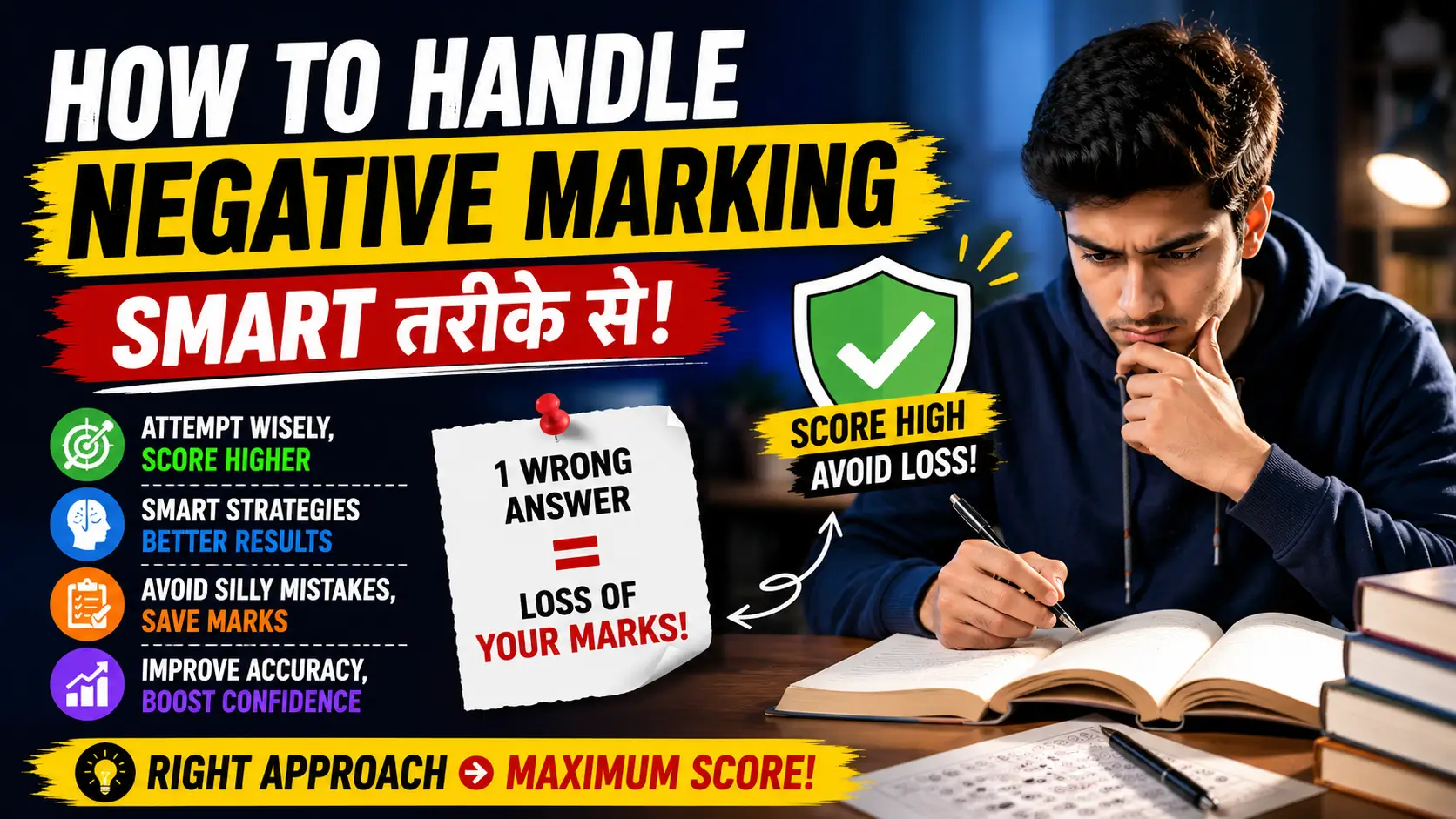
Before I explain you how to handle negative marking, I want to ask you a question. The last time you took a competitive exam, did you ever skip a question even though you knew the answer, thinking, “If I get it wrong, marks will be deducted.” Or did it happen the other way around? Did you attempt a question even though you didn’t know the answer, just because you felt you had to write something?
Both scenarios relate to negative marking and impacted your total score.
Friends, thousands of students like you face this exact problem. They do well in mock tests but fall behind in the real exam because of negative marking. This happens because they were never properly taught how to handle negative marking.
If I talk about myself, I used to do the same thing earlier. Every question that seemed a little confusing, or which I was not even 50% sure of, I used to try on it thinking – “Who knows, Maybe a lucky guess will work!” But a lucky guess doesn’t always pay off; most of the time, the answers turn out to be wrong. Inside the exam hall, 0.25 or 0.50 negative marks seemed very small. But at the end of the exam, when I saw the total, I realized that these small marks together had a huge impact on the score.
That’s when I understood that negative marking is not just a rule to deduct your marks, but it also tests your decision-making ability.
And today I will explain to you step by step how to handle negative marking.
Table of Contents
What is Negative Marking?
If I say in very simple words, when you mark an incorrect answer to a question, then along with the marks of your wrong answer, some marks are also deducted from the marks earned for the correct answers. For Instance, in a competitive exam, negative marking will be applied this way – you receive 2 marks for a correct answer, while 0.50 marks are deducted for every incorrect one. This means that giving four wrong answers could cost you marks equivalent to one correct answer. That is why in competitive exams, not only knowledge but decision making is also important.
📌 You can calculate your negative marking here.
Why is There Negative Marking?
First, we need to understand why the negative marking system is in place in exams. If you think it exists solely to deduct your marks, you are mistaken. Your decision-making abilities are also tested. Examiners want to see how you react when faced with uncertainty.
Do you take a chance without thinking? Or do you use your judgement to choose the right path? Every wrong decision in the exam hall puts you behind thousands of students. Therefore, do not think of negative marking as a hindrance. Instead, think of it as a tool that, when used correctly, can help you get ahead of the rest of the crowd.
📌Also Read: GK याद नहीं रेहता ??? Then Use This 5 Smart Tricks. Read Here
1. The 50-50 Rule: Learn to eliminate options
This is one of the best methods to reduce negative marking. Elimination is a skill that many students overlook, but it is actually a very powerful trick. When you face a question for which you do not know the direct answer, do not immediately resort to guessing (“Tukka”) or skip it entirely. Instead, use the elimination method first. This means that out of four options, identify and eliminate the ones that are absolutely wrong first.
Suppose you know that option A and option B cannot be the answer to this question. Now you are only left with two options: C and D. Here, your chance of being correct is 50 percent. You can afford to take a calculated risk on such questions.
But if you have absolutely no idea any of the four options, then skipping that question is the best course of action. You can practice this method during mock tests. Before deciding to skip any question, try eliminating it. This habit will be very useful in the exam.
2. Use the Three-Round Strategy
In the exam hall, you should always solve the paper in three rounds. Many beginners start marking answers from the very first question and then waste time trying to solve difficult ones. This is a very flawed approach.
In Round 1, attempt only those questions where you are 100% certain of the answers. Solving these questions will significantly boost your confidence and naturally generate positive energy.
In Round 2, you should solve those questions where you have already eliminated two options. Here, use your brain a little and take a calculated risk based on logic.
You should attempt questions in Round 3 only if your total number of attempts is very low. If you have already answered a good number of questions correctly in Rounds 1 and 2, it is better to skip Round 3 entirely.
I have used this strategy myself, and it reduces the pressure considerably. When the pressure is low, the mind makes better decisions.
📌 Also Read: Kya Competive Exam crack karne ke liye Self-study kaafi hai? Kaise kare Self-study? Read Here
3. Manage Your Time to Minimize Negative Marking
Time management plays a crucial role in minimizing negative marks. We often have a habit of saving difficult questions for the very end. However, when time runs short towards the end of the exam, we tend to make decisions in a rush. And hasty decisions are often turn out to be wrong.
We all have a habit of leaving difficult questions for the last time. And at the end of the exam, when time is short, we make hasty decisions. And hasty decisions often turn out to be wrong. Therefore, attempts made in the last 15 minutes carry a high risk of negative marking.
The solution is to plan your time in advance.
In the first round, tackle the questions you are certain about. Skip the doubtful ones, but mark them for review. Once the first round is complete, check how much time remains. Then, in Round 2, use that time to address questions where you can apply the elimination method.
Last-minute random guesses often do more harm than good.
By following this approach, you’ll never get into panic mode at the last minute. And panic mode is the state where maximum negative marking occurs.
4. Read the questions thoroughly and attentively
You may be surprised to know that approximately 10-15% of questions are answered incorrectly simply because students fail to read them carefully. In the exam hall, our minds are racing and we are often in a rush. Misreading a question is a common occurrence in such situations, that we often realize only when reviwing the paper later at home. By then, nothing can be done but to regret it. These mistakes also contribute to your negative marking.
Sometimes, even when you have read the question properly and know the correct answer, but in a hurry, you mark option C instead of option B.
Save yourself from making these mistakes. Taking just two extra seconds to read and solve a question can save you many valuable marks.
📌 Also Read: Competitive Exam preparation के दौरान consistent कैसे रहें? Read Here
5. Track Negative Marking in Mock Tests
This is something many students overlook.
No matter how many techniques you learn, they won’t be useful unless you practice them. Whenever you take a test at home, don’t just look at your total score. Conduct a separate analysis to see how many questions resulted in negative marking and identify which topics or subjects caused the most errors. Also, determine the reason behind them- were you confused, or did you simply guess?
To do this, maintain a separate “Mistakes Notebook” where you write down the reasons for the mistakes you made during mock tests. Was that mistake a silly one? Did you misunderstand a concept? Or was it a wild guess? Writing down your mistakes helps your brain remember them. The next time a similar question appears, your mind will immediately become alert.
Conclusion
Negative marking is not something you should be afraid of. But ignoring it is also a mistake. The right approach is to understand it and devise your strategy accordingly.
It is simply a test of discipline. Students who control their emotions and greed can easily clear any exam.
To avoid negative marking, try to apply the steps mentioned above. This won’t happen overnight. But the more you practice, the more natural it will become. Then the fear of negative marking will go away from your mind, and your result in the exam will improve significantly.

Hi, I’m an exam aspirant who has successfully cleared SSC and other government exams, and I’m currently preparing for the UPSC.
I love writing and creating content for fellow aspirants. Through StudyBlink, I share study hacks, book reviews, and exam strategies to help you stay motivated and succeed in your journey.