
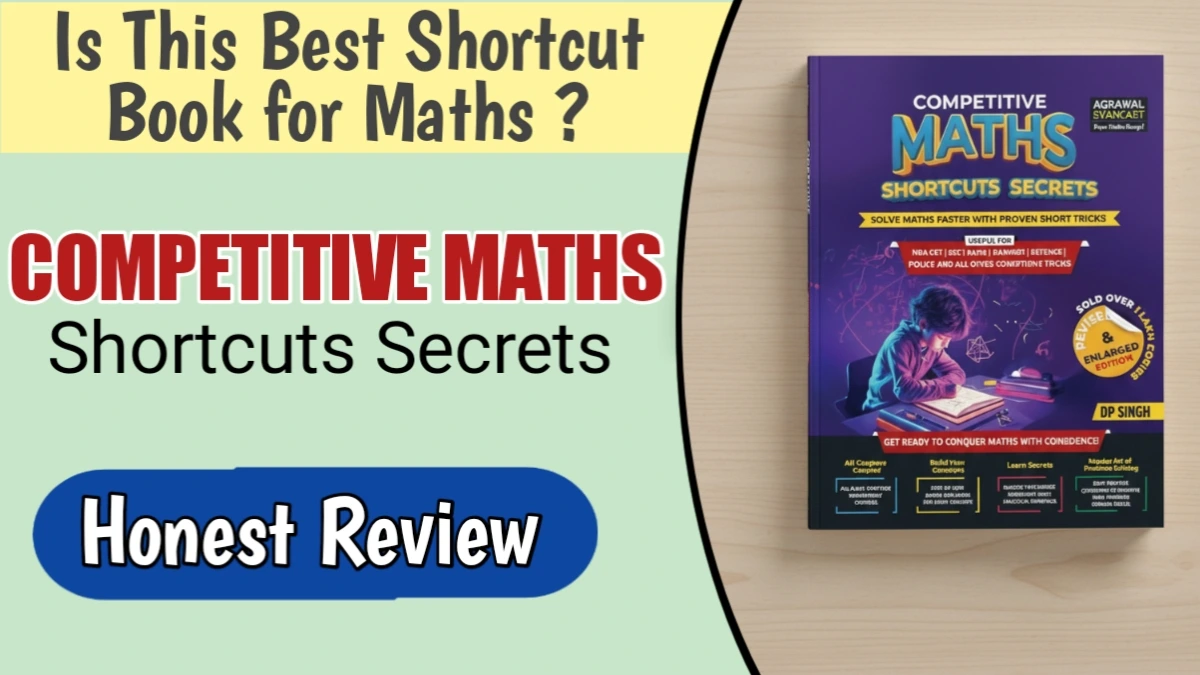
If you’re preparing for competitive exams, you know that math is one of the toughest and most time-consuming subjects. Many students, despite knowing the basic concepts, struggle to solve exam questions quickly. And that’s where the real problem begins, because every second counts in these exams. Therefore, you need shortcuts to crack the exam.
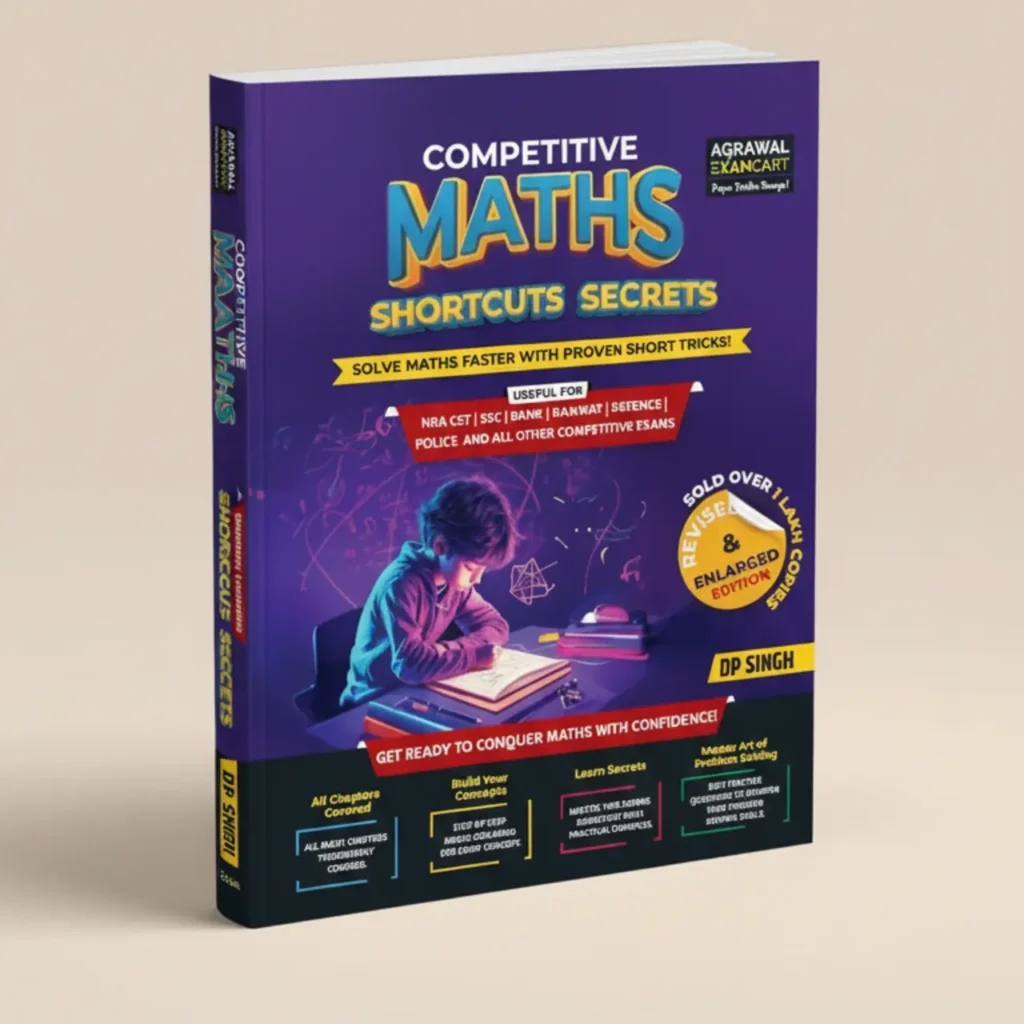
There are plenty of similar books on the market that cater to this need of aspirants. But one book that is talked about a lot for its shortcuts is Competitive Maths Shortcuts Secrets by DP Singh, published by Agrawal Examkart Publication. With this book, you can learn fast tricks and also improve your accuracy. This book is very useful especially for SSC, Railway, Bank, NRA CET, Defence and other one-day exams.
I have read this book thoroughly and checked its content. Based on this, I am going to write a simple, honest and complete review of this book which will help you decide whether this book is right for your preparation or not.
Table of Contents
Quick Overview
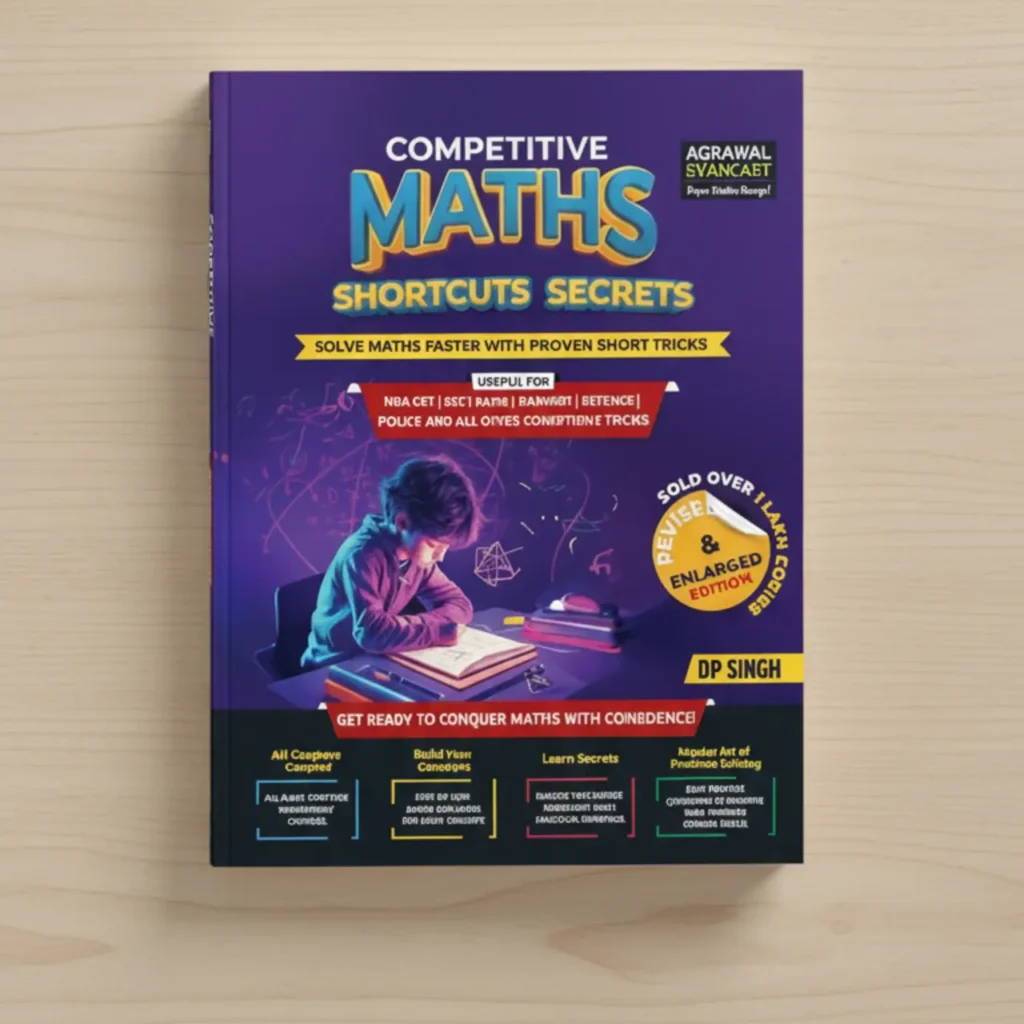
As I mentioned earlier, learning a fast-solving method is very important for scoring good marks in Math in competitive examinations. In fact, this is the difference between you and a topper. Even a small delay can impact your marks and final rank. All serious students want to learn shortcuts, but often get confused because the tricks are scattered across different books and videos.
This book attempts to solve this problem. It gathers important shortcuts, basic concepts, and exam-based question types in one place. The structure of the book is simple: first it teaches you the concept, then the shortcut, then examples, and at the end, there are type-wise practice questions.
The book starts with simple calculation tricks and gradually moves to higher-level topics. Because of this, even beginners can easily connect.
Let’s take a detailed look at what this book covers.
📌 For More Reviews of Competitive Exams Book Explore Our Site StudyBlink.com
Content Coverage
The book contains 29 chapters. All chapters begin with basic calculations and progress to advanced topics. Some important chapters:
- Speed up your calculations
- Number System
- HCF & LCM
- Square, Square Root, Cube, Cube Root
- Surds and Indices
- Fractions and Decimal Numbers
- Simplification and Approximation
- Algebra Geometry
- Mensuration
- Trigonometry
- Data Interpretation
- Probability
- Time, Work and Distance
- Partnership
- Profit & Loss
- Ratio and Percentage
- And many more useful chapters
The same pattern has been kept in every chapter.
1. Concepts
2. Short Tricks
3. Solved Examples
4. Type-wise Questions
5. Pattern-based Question Sets
This structure makes the book easy to understand, revise, and self-study.
Best for Whom?
This book is most useful for those students.
- SSC CGL, CHSL, MTS, CPO aspirants
- Railway exam students
- Banking students (mainly prelims speed practice)
- Police and Defense exam aspirants
- Students who are starting to learn shortcuts
- Students who want all the shortcuts in one book
- Beginners who need simple explanations
- Repeat students who need fast revision
Even if you know basic math, applying the shortcuts given in this book can improve both your speed and accuracy.
Strengths of the Book (Pros)
a) Very Good Type-Wise Structure
Each chapter in the book is divided by type-wise questions. This helps us understand how many patterns are there in a topic and how to solve them.
b) Strong Focus on Shortcuts
The book fully lives up to its name. It includes shortcut formulas, smart methods, and fast techniques. All of these shortcuts are based on previous exam patterns.
c) Concept First, Tricks Later
Another special thing I liked about this book is that it gives equal importance to concept building. There are many shortcut books on the market that start directly with tricks. But this book first explains the concepts and then teaches you the tricks. It is helpful for beginners.
d) Almost every math topic is covered.
This book includes every chapter from the number system to trigonometry. Due to its wide coverage, it is useful in almost every competitive exam.
e) Simple Language
The language in this book is clear and easy to use. Even difficult ideas/tricks are explained in a simple manner.
f) Best for Speed Improvement
If improving your speed is my goal, I think this book will be a great help.
In the Calculation Shortcuts chapter:
- Fast Addition
- Fast Subtraction
- Smart Multiplication
- Quick Division
- Digit-Based Methods
All of this is covered.
g) Practice Questions for Every Pattern
The book isn’t just about shortcuts. You also get practice sets with solved examples, which strengthens your preparation.
h) Exam-Based Approach
This book is completely exam-oriented. Practice questions are based on the pattern of SSC, Railway, and one-day exams.
i) Affordable Price
The book is also quite budget-friendly. You can purchase this book online in the price range of ₹220-₹250.
📌 Also Read: Lucent GK vs Arihant GK- Which GK book is best for you? Check our honest comparison. Click Here
Weaknesses of the Book (Cons)
No book is perfect. This book also has some drawbacks.
a) It is not a full theory book.
It is primarily a shortcut book. So, you won’t find much theory content in it. Those who want deeper theory will need a separate theory book.
b) It is not perfect for the Banking Mains level.
In my opinion, this will be more helpful for Prelims. Banking Mains requires a detailed understanding, so you may want to check out another book.
c) Some Topics May Seem a Little Short
The main aim of this book is to build your speed and improve your accuracy, not deep theory, so you may find some topics a little short.
📌 Lucent GK Vs Arihant GK- which is best for you? Check our honest comparison. Click Here
How to Use This Book for Best Results
If you want the best results from this book, follow this plan.
Step 1: Start with the Basics
Read the conceptual section first. Clear your fundamentals. Without learning the basic concepts, you can’t learn the tricks.
Step 2: Learn Shortcuts
It’s important to understand the tricks; you can’t solve math by memorizing them.
Step 3: Check Solved Examples
Check examples along with shortcuts. These solved examples show how to use the shortcuts in real questions.
Step 4: Practice Questions Type-wise
This step is the most important. Practice builds both speed and confidence.
Step 5: Revise Weekly
Shortcuts only work if you revise them regularly. So, solve PYQs using these shortcuts every week.
Ratings (Out of 5)
| Category | Rating |
| Content Quality | 4.5/5* |
| Shortcut Collection | 5/5* |
| Ease of Understanding | 4/5* |
| Exam Relevance | 4.5/5* |
| Practice Questions | 4.2/5* |
| Value for Money | 5/5* |
Overall Rating :4.5/5
Final Verdict
Competitive Maths Shortcuts Secrets by DP Singh is a strong and exam-focused book that is useful for students preparing for every competitive exam.
This isn’t a heavy theory book, but if your main goal is to improve speed, accuracy, and confidence, this book will be quite helpful.
It’s especially useful for:
- SSC
- Railway
- Police
- And other one-day exams
The type-wise structure, clear explanations, and shortcut collection make it suitable for both beginners and repeat students.
If you want a book that teaches you how to solve questions quickly and helps you revise math before exams, this book is a good option.
Latest Posts:
- Why Oswaal Vocabulary Builder Is a Game-Changer for Aspirants?
- How to Handle Negative Marking: A Complete Guide for Aspirants
- Master GK Faster: 5 Smart Techniques That Really Work
- Is Self Study Enough for Competitive Exams in 2026 for Beginners?
- 10 Common Mistakes Beginners Must Avoid in Competitive Exam Preparation

Hi, I’m an exam aspirant who has successfully cleared SSC and other government exams, and I’m currently preparing for the UPSC.
I love writing and creating content for fellow aspirants. Through StudyBlink, I share study hacks, book reviews, and exam strategies to help you stay motivated and succeed in your journey.