
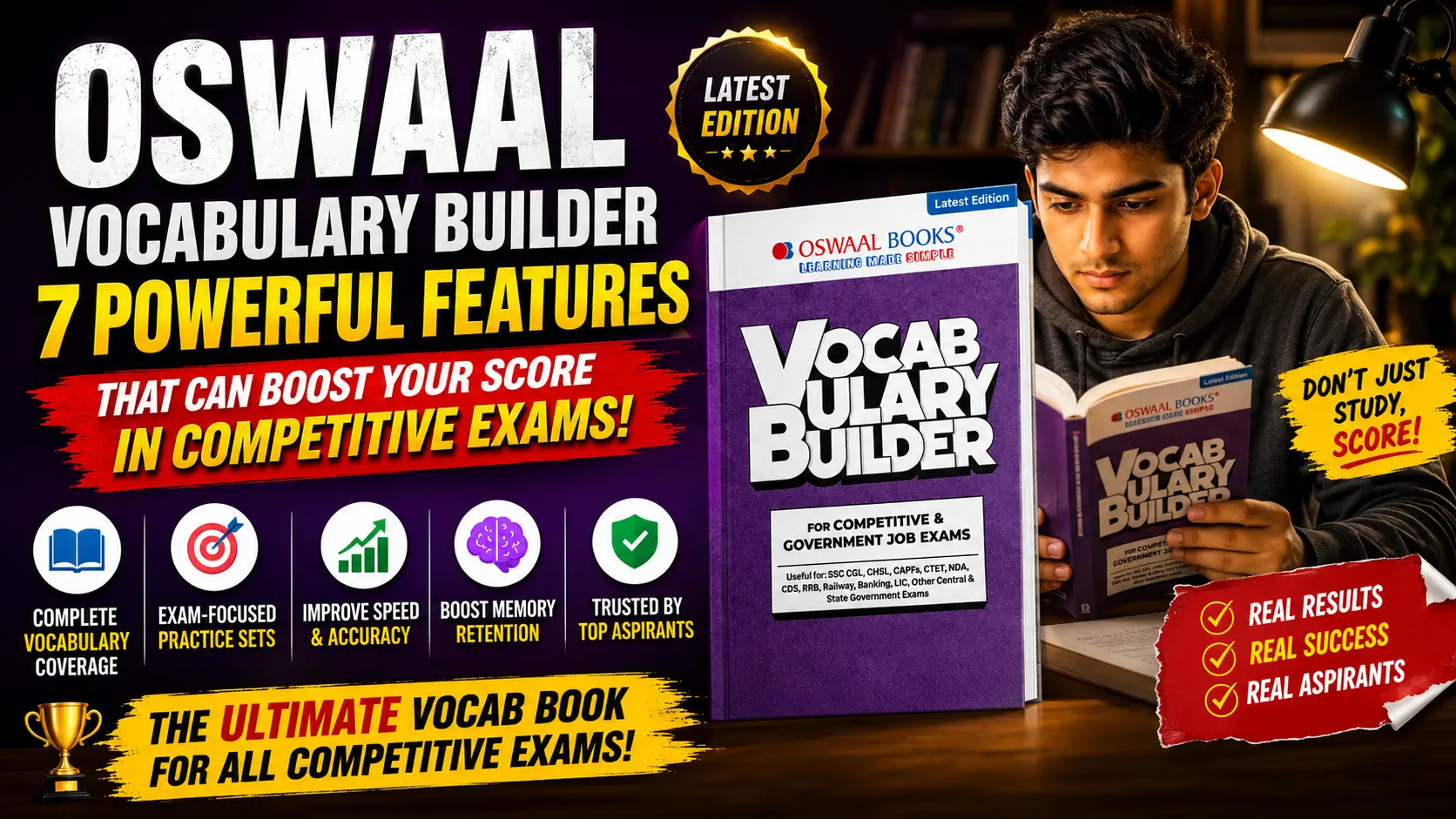
Many students try to attempt exams by just memorizing word meanings, which is not the right approach for this problem. The exams are generally conducted having questions on synonyms and antonyms, one word substitution, idioms, phrasal verbs and word usage in sentence l questions. If the actual use of the word is not understood, it becomes difficult to choose the right answer.
Table of Contents
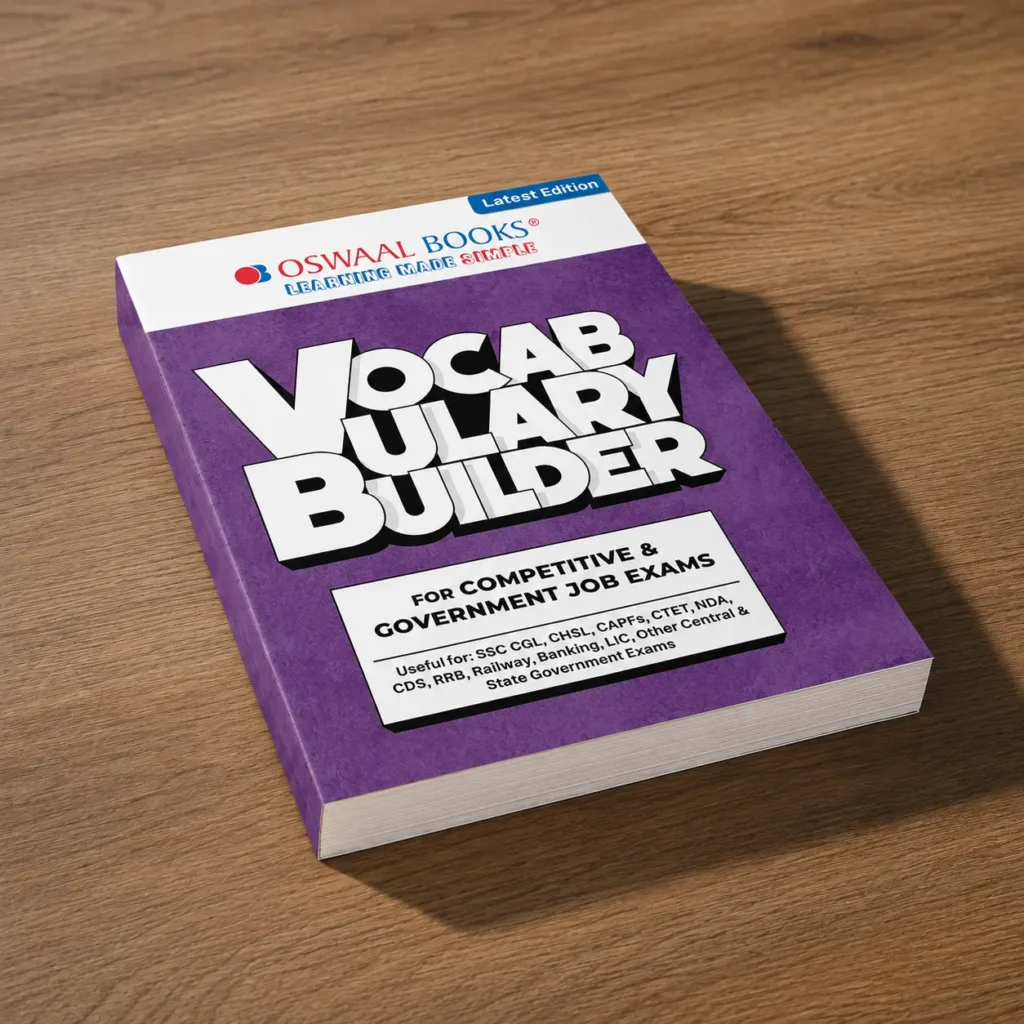
Keeping this problem of students in mind, Oswaal Books has published a book named “Vocabulary Builder for Competitive and Government Job Exams.” This book includes many excellent contents like explaining focus words with context, improving sentence building, providing exam-oriented practice, etc., which makes it different from other books available in the market. But being different from other books does not make a book better from the student’s point of view.
So today we will review Oswaal Vocabulary Builder book part by part in detail and see what all is covered in this book, what are its strengths and limitations, which students it is most useful for, and whether this book can be a good choice for your competitive exam preparation.
Who Should Buy This Book?
Every student may not have the same requirement. Some students may need to build their concepts from the scratch while others may only need to practice some problems or simply need revision. By analyzing the Oswaal Vocabulary Builder, we can say that it has been made to meet the requirements of aspirants of different levels.
📌SSC Aspirants
Students appearing for exams like the SSC CGL, CHSL, MTS, CPO, or Stenographer, must focus on the vocabulary section since it is an important part of the syllabus. This book covers topics like synonyms, antonyms, one-word substitutions, idioms, phrasal verbs, and editorial vocabulary in detail. Hence, it can be helpful for students preparing for the SSC Exam
📌Banking Aspirants
The English section in the Bank PO and Clerk exams is quite high. A strong vocabulary directly benefits in the Reading Comprehension and Cloze Tests. Newspaper-based vocabulary and sentence examples make this book a useful resource for banking aspirants as well.
📌Railway, Defense, and Police Exams
Vocabulary-related questions are regularly encountered in RRB, NDA, CDS, CAPF, Police, and other one-day exams. The book’s chapter-wise format and practice sets make revision easy, which can be helpful for these exams.
📌UPSC and State PSC Aspirants
Memorizing word meanings alone is not enough for the UPSC and State PSC exams. Editorial vocabulary and context-based learning are especially important. This book’s newspaper vocabulary section and root-word approach help candidates understand the actual meaning and usage of words.
📌Beginners
If you are new to the English language, then you can start learning the vocabulary from the book. It not only provides the definitions of the words but also explains their application in day-to-day life. The book allows to practice the questions in a step-by-step manner.
📌Students Who Prefer Self-Study
If you don’t want to join coaching institute and prefer self-practice, then this book is for you. After studying all the concepts, you can test your knowledge by answering the questions given in the book. The book also provides detailed explanations for each answer, helping you to assess yourself
📌Also Read: Lucent GK vs Arihant GK – which GK book is best for you? Read Here
What Does the Book Cover?
The biggest strength of Oswaal Vocabulary Builder is its well-organized content. The book is divided into approximately 13 major parts, systematically covering every topic.
This book doesn’t just provide vocabulary lists. Different methods are used to understand, memorize, and apply vocabulary for exams.
1. Vocabulary Essentials
The book begins with the basics of the English language. This section explains important concepts related to sentences, phrases, clauses, parts of speech, gerunds, and vocabulary.
In addition, the basic differences between synonyms, antonyms, homonyms, homographs, polysemous words, and root words are explained in simple language.
2. Newspaper Vocabulary
This section is the most engaging one in the entire book. Words commonly found in newspapers, especially in the editorial section are divided into separate categories. Each word is explained with the help of, Their parts of speech, Meaning, Synonym, Antonym and a sentence built using that word.
The method really helps the readers to grasp the exact application of a word in a sentence and thus, develop better writing skills.
3. Thematic Vocabulary Lists
Various words are divided under different categories, such as:
- Phobia Words
- Philia Words
- Mania Words
- Logy Words
- Graphy Words
- Crazy Words
- Scientific Instruments
- Forms of Worship
- Foreign Words
- Age-Related Words
This type of categorization makes revision much easier.
4. One Word Substitution
One word substitution is a very important topic in competitive exams. In this section, commonly asked one-word substitutions are explained with examples, making them relatively easy to remember.
5. Root Words
This section is very useful for those students who want to learn vocabulary logically.
If you are unable to identify the meanings of certain words on the exam, studying their root will greatly enhance your chances of answering them correctly.
6. Confusing Words
There are various words in the English language that have similar spellings and completely different meanings. For instance- Affect / Effect, Accept / Except, Complement / Compliment etc.
The book highlights such words and explains their meanings with the help of sentences.
Key Features of Oswaal Vocabulary Builder
Vocabulary books are widely available in the market, but not all books have the same learning approach. Oswaal Vocabulary Builder offers several features that set it apart from traditional vocabulary books.
1. Context-Based Learning Instead of Rote Memorization
The biggest highlight of this book is that it does not teach the meaning of words through rote learning.
For every important word, the book provides its meaning, synonyms, antonyms, and an example of a sentence formed using that particular word. This helps students understand how a word is actually used within a sentence.
This approach helps not only in exam preparation but also in improving reading comprehension and overall English proficiency.
2. Editorial Vocabulary from Newspapers
The editorial vocabulary of newspapers is gaining importance these days in various competitive exams.
This book has sourced important words from the editorial page of renowned newspapers like The Hindu and The Indian Express.
Moreover, in this book, words have been explained in context to current affairs, which will help the students to enhance their vocabulary as well as knowledge of current affairs simultaneously.
This section is really helpful for those students who do not have the habit of reading newspapers on a regular basis
3. Infographics and Mind Maps
Unlike other vocabulary books, this book uses infographics, charts, and mind-maps to make the learning process more interesting and engaging. Also, in comparison to traditional books, it is easy to revise topics through these visual modes of representation.
This feature helps visual learners to grasp and retain concepts easily.
4. Root Word-Based Learning
New words frequently appear in competitive exams. If you understand root words, then guessing the meaning of unfamiliar words becomes easier. The book’s ‘Root Words‘ section is designed specifically for this purpose.
So, this is really helpful for the students, not only in competitive exams but also to improve their overall English proficiency.
5. Dedicated Sections for High-Scoring Topics
The book has dedicated sections for topics that are frequently asked in competitive exams. Such as: One-Word Substitutio,Idioms & Phrases, Phrasal Verbs, Fixed Prepositions, Parts of Speech, Confusing Words
This topic-wise arrangement makes revision easier.
6. Chapter-wise Practice Sets
Reading theory alone does not build a strong vocabulary. Practice questions are provided Immediately after every major section to help the students to test their knowledge and understanding about the chapter.
This approach makes learning more effective.
7. Detailed Answer Explanations
This feature adds significant value to the book. The solutions to the practice questions do not merely provide the correct option. The meanings of the incorrect options are also explained.
The benefit of this is that while solving a single question, you learn not just one, but 3-4 new words.
8. Previous Year Questions
The book also includes questions from previous years. These help students understand the exam pattern and the way vocabulary questions are asked.
Solving PYQs also improves confidence.
9. QR Code Support
The latest edition of the book includes QR Codes. By scanning these codes, students can access updated study materials and additional resources.
This feature helps keep the book relevant to current exam trends.
📌 Also Read: What are the common mistakes that beginners must avoid? Read Here.
What Makes This Book Different from Other Vocabulary Books?
There are plenty of vocabulary books available in the market. But the thing is most books just have alphabetical word lists or follow a dictionary-style pattern.
Oswaal Vocabulary Builder stands out by taking a slightly different approach.
The primary difference is its sentence-based learning approach. The book teaches the meaning of the word by using them in sentences. This way, the students can remember the examples where the word has been used and they also get to know the practical implementation of the word.
Another major difference is its newspaper vocabulary section. Words taken from editorials are highly relevant for competitive exams. This makes the learning process exam-oriented as well.
A third difference is its visual presentation. Infographics, charts, and mind maps make learning vocabulary comparatively more interesting. This feature is rarely found in traditional books.
The last difference is that the book gives equal focus to theory as well as practice. Each chapter is followed by practice questions and their detailed solutions. This allows students not only to study the material but also to immediately test their preparation.
So, in conclusion we can say that this book doesn’t just give a list of words but rather provides an insight of how to learn vocabulary in an organized manner.
Pros of Oswaal Vocabulary Builder
Every book has its strengths and limitations, and Oswaal Vocabulary Builder is not an exception. However, this book has various advantages for those who want to prepare for competitive exams that make it a strong choice.
1. Well-Structured Content
As I have already mentioned earlier, this book is organized in a highly systematic manner. It begins with basic concepts and gradually covers advanced vocabulary topics which makes it easy for even for beginners to understand the content.
2. Practical Learning Approach
In addition to the structured presentation of the content, another advantage of this book is a practical approach. Every important word is explained through sentences. This naturally improves vocabulary and helps you understand the actual meaning of the word.
3. Excellent Editorial Vocabulary Section
It is always hard to select the most relevant words from newspapers for the competitive exams preparation. However, this book offers high-quality editorial vocabulary, which is taken from reputed newspapers.
It means that if someone does not have enough time to read newspapers, this guide will help them achieve success in competitive exams.
4. Root Word Method Makes Learning Easier
Most books lack the effective method of teaching vocabulary via root words. However, Oswaal Vocabulary Builder has this useful tool, which makes the process of learning new words much easier. Besides, it is helpful for those who want to learn vocabulary for a long time.
5. Infographics and Mind Maps
Visual learning tools set this book apart from traditional vocabulary books.
Tables, charts, and mind maps help quick revision and make important topics easier to remember.
6. Strong Practice Section
Practice questions are provided after every major chapter.
This allows students to quickly evaluate their preparation and identify their weak areas.
7. Detailed Explanations
When I look at the solutions to the practice questions, they provide more than just answers.
The meanings of incorrect options are also explained. This provides an opportunity to learn multiple words while solving a single question.
8. Updated According to Current Exam Trends
The content in the book has been prepared keeping in mind the latest exam patterns.
This is a crucial factor for competitive exam preparation.
Cons of Oswaal Vocabulary Builder
No book can be a perfect one. Here are a few minuses of this book, which may disappoint some of the students.
1. English Medium Only
This book is written in English. Students with weak English basics or those preparing via the Hindi medium might face some difficulty in the beginning.
2. Vocabulary-Focused Resource
The book focuses entirely on vocabulary. Grammar, Reading Comprehension, and other English topics are not covered in detail. Therefore, you will need additional books for comprehensive English preparation.
3. Not Meant for Last-Minute Preparation
The content in the book is quite detailed. If the exam is just a few days away and you are looking for a resource for quick revision, completing this book might be difficult.
4. Regular Practice Is Necessary
Simply reading the book will not improve your vocabulary. You will get the maximum benefit from it only if you engage in regular revision and practice
How to Use This Book Effectively
To get the maximum benefit from this book, it is essential to follow a proper study plan.
Step 1: Start with Vocabulary Essentials
Do not skip the first section of the book. Understanding sentence structure, parts of speech, and basic concepts makes the subsequent chapters much easier to grasp.
Step 2: Learn 20–30 Words Daily
Instead of trying to memorize a large number of words at once, learn a few words daily. Make sure to study the meaning, synonyms, antonyms, and example sentences for each word.
Step 3: Focus on Root Words
Revise a few root words every week. This habit will greatly help you in understanding new words in the future.
Step 4: Solve Practice Questions Immediately
After completing the theory, be sure to solve the chapter’s practice questions. This will help you gauge how clearly you have understood the concepts.
Step 5: Revise Weekly
Vocabulary is retained only through regular revision. Make sure to do a quick revision of difficult words at the end of the week.
Step 6: Use Alongside Previous Year Questions
Solve Previous Year Questions (PYQs) after learning vocabulary from the book. This will help you understand the exam pattern and boost your confidence.
Final Verdict
If you are looking for a vocabulary book for competitive exams that isn’t limited to just word meanings, Oswaal Vocabulary Builder could be a strong option. The book’s greatest strength is its structured approach. Vocabulary is taught through sentence examples, editorial words, root words, infographics, and chapter-wise practice exercises. This way, learning isn’t limited to memorization, but also helps you understand concepts.
However, if you are seeking an all-in-one resource for comprehensive English preparation, you will still need separate books for grammar and comprehension. Yet, strictly from a vocabulary perspective, this book is quite comprehensive.
If you are preparing for exams like SSC, Banking, Railway, UPSC, Defence, CUET, or any other government exam and wish to strengthen your English vocabulary, this book certainly deserves a place on your bookshelf.
Verdict: Highly Recommended. This book is a worthwhile investment for aspirants who want to not only memorize words but also understand them thoroughly and use it confidently in the exam.
📌 Latest Posts:
- Why Oswaal Vocabulary Builder Is a Game-Changer for Aspirants?
- How to Handle Negative Marking: A Complete Guide for Aspirants
- Master GK Faster: 5 Smart Techniques That Really Work
- Is Self Study Enough for Competitive Exams in 2026 for Beginners?
- 10 Common Mistakes Beginners Must Avoid in Competitive Exam Preparation

Hi, I’m an exam aspirant who has successfully cleared SSC and other government exams, and I’m currently preparing for the UPSC.
I love writing and creating content for fellow aspirants. Through StudyBlink, I share study hacks, book reviews, and exam strategies to help you stay motivated and succeed in your journey.